


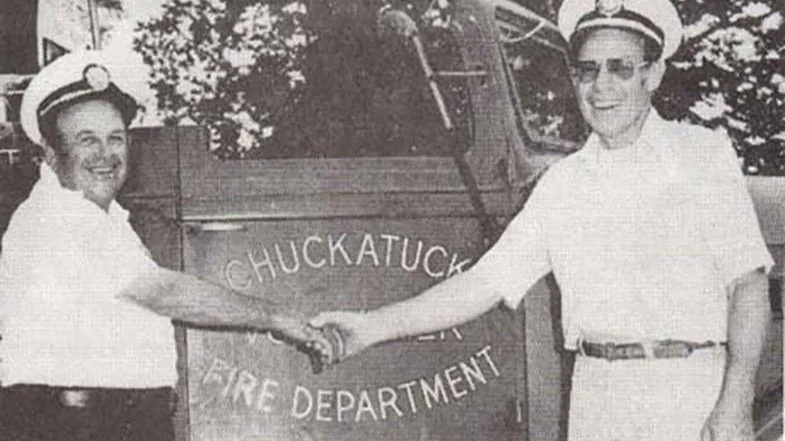
John Kelly and Al Saunders, first and second chief of CVFD
The majority of the information in this chapter has been derived from publications compiled by Emma Mae Kelly in the 1960s and 1970s, as well as discussions with Jerry Saunders, the current Assistant Chief of the Volunteer Fire Department. The publications by Emma Mae Kelly are available at the GCHF and will be part of the media files available for review. Every person who reads Chuckatuck: Crossroads in Times should take advantage of these materials, as they contain a wealth of information about the fire department and the local community.
In the early years of Chuckatuck, several fires within the GCH area required attention from the fire departments of either Suffolk or Smithfield. Each of these was about 10 miles from the center of the GCH area. Between 1917 and 1921, the former Colonel Phillips Military School, then the residence of Corbell Cotten, burned. A bucket brigade was used, but it was unsuccessful. In 1917, the L.L. Eley home burned to the ground with only a well on the premises to fight the fire. In 1927, two barns on the land that is now the location of the old Spady home burned, attended by the Suffolk Fire Department. In 1933, Dr. F.A. Morrison’s home (behind Kitty’s Beauty Salon) burned to the ground. We believe this to be the antebellum home of the Ramseys, across the street from the Moore home. The Suffolk Fire Department worked to hold the fire to one home. In 1934, the Hodsden home, Concord, near Wills Corner, was destroyed by a late-night fire.
The Suffolk Fire Department did not respond when called due to some conflict between the City Council and the Nansemond County Board of Supervisors. A letter from Mr. Hodsden to the Suffolk News-Herald (on file at GCHF) revealed lots of help from locals, but none from the Suffolk fire department for a 6-to 10-foot ladder or some chemicals. The results were a total loss of a beautiful home known as “Concord”. It was not until 1950 that an agreement was reached in the perennial disagreement between the City of Suffolk and the Nansemond County Board of Supervisors, stipulating that a fee of $50.00 would be paid for each fire department call within the County territory. In 1935, the B.W. Godwin sawmill was destroyed in its entirety, with help from members of Chuckatuck High School who formed a bucket brigade and the Suffolk Fire Department. In 1940, the grain barn at Pembroke burned. Although Smithfield responded, upon arriving in Chuckatuck, they were told the fire was out. They returned to Smithfield, only to be called again and return, standing by the fire for the rest of the night. The barn was a total loss. In 1945, the Chuckatuck High School library burned down, and students threw books out of the windows. Ultimately, the Suffolk Fire Department arrived to put out the fire. In 1951, the Kirk Lumber Company experienced a fire, to which the Suffolk Fire Department responded. In 1954, P.D. Pruden at Everets Bridge had a fire, and the Suffolk Fire Department responded.
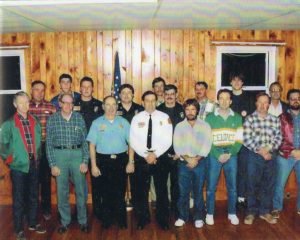
It was at this time that Mr. Bill Harvell realized Chuckatuck needed a fire department, so he approached Mr. J.R. Kirk for help. The Chuckatuck Volunteer Fire Department (CVFD) had its beginnings in 1954, when Mr. Kirk purchased and donated a 1942 Maxim fire truck. This truck came from Langley AFB as surplus and would be more than acceptable once it was outfitted with all of the essential equipment generally used on a fire engine. The engine was stored in the Spady garage until a firehouse could be constructed. The initial membership of 50 was formed with men from Chuckatuck, Crittenden, Eclipse, Everets, Hobson, and Reids Ferry.
In early 1955, there was a house fire on the lane next to Wesley Chapel Church that took the lives of five children trapped in the upstairs bedrooms. The house, one of three along that road owned by Lone Star Cement Corp for its employees, was a small two-story home that housed the family of Mr. Robert Eley, a Lone Star employee. The fire's origin was such that once outside, no one could return to the house to rescue the children. Some of them could be seen at the window, but the screen wire tacked on the outside was a deterrent to escape. Arthur Joyner, working on the dragline very close by, observed the fire and notified Mr. Harvey Saunders, Sr., Mr. Staylor, the superintendent, and Mr. Archie Fronfelter, dragline operator, who lived very close to this area, but Lone Star Cement Corp had no external firefighting capability. The CVFD was not notified; however, they could have responded within a few minutes if the volunteers had been notified. Smithfield responded and kept the next home of Booker T. Chapman sprayed with water to protect it from the fire. Due to the construction of the house, the fire spread rapidly, and the house was destroyed before Smithfield arrived. The oldest child in this family had drowned in the Marl Hole several months before the fire, which caused “No Trespassing” signs to be placed at all entrances to the pits. This was the first and only drowning in the Marl holes that we know of. Note: This writer lived just a few houses away and remembers the fire as if it were yesterday. The fire and smell associated with the deaths will always be foremost in my mind. This was a crowning blow for Mr. Eley, having lost all of his children in these two instances.
Although the firehouse was being built on land sold to the group by Dr. L.L. Eley, this fire may have been the catalyst for completing the CVFD building as soon as possible. Housed in the Spady garage, with no heat, the fire truck could not be filled with water due to the risk of freezing in winter, highlighting the need for a new firehouse. The Ladies Auxiliary of the fire department held bazaars, and the Chuckatuck Ruritan Club made donations to support their efforts. Richard A. Davis was the president of the Chuckatuck Ruritan Club at the time and was actively involved in organizing the CVFD. The Ruritan Club has been most active in donations to the organization every year since its inception. Fire Department dances and fundraisers, such as the semiannual fish fries, have become a must-attend event each year, providing significant financial support for this volunteer organization. They will serve 1500-2000 meals at any given “all you can eat” event. Al Saunders served as Chief from 1954 to 1963, when John Kelly was elected. John served as Chief until 1986. Jerry Saunders until 2002, Greg Parsons from 2002 - , and Ben Johnson from 20 until the CVFD was replaced by the City of Suffolk in .

Many residents of Chuckatuck and its surrounding communities have been involved in the fire department in some capacity. The list of those who have volunteered their services is long and comprehensive. The original list of charter members in 1955, the founding fathers, has all passed away except for Al Saunders. The 1956 membership list has only two members still living today: Al Saunders and Jerry Saunders. Some members have been with the department since its inception. For example, Jerry Saunders has been an active member of the department for over 55 years, was Chief for 16 years, and is currently the Assistant Chief. Alex Winslow joined in 1957 and has also been active ever since. Vernon Gayle has been with the department since 1958. Others have moved to inactive status for health reasons, such as Al Saunders, the first Chief. In 1997, the new fire station was dedicated in its current location, providing more capabilities and space as the city continued to grow.
New equipment has been purchased over the years, and when passing through Chuckatuck, you will see the new firehouse and all its equipment on display, ready to roll. Limited personnel are on site with many volunteers in the communities connected by beepers and landlines, prepared to move on a moment’s notice. In every respect, the CVFD is a well-organized, outstanding volunteer group that responds rapidly when needed. This station will respond to an average of 300 calls per year and support other local and city fire departments as needed. Due to a decline in available firefighters during the day, Suffolk City placed a paid department in Chuckatuck in .